Showing posts with label God. Show all posts

Sunday, October 28, 2018

choose life, choose Christ

artwork by Krista Hamrick

This beautiful artwork by Krista Hamrick inspired me to do a study based on Ruth 1:16

NASB: But Ruth said, "Do not urge me to leave you or turn back from following you; for where * you go, I will go, and where you lodge, I will lodge. Your people shall be my people, and your God, my God.

BBE: But Ruth said, Give up requesting me to go away from you, or to go back without you: for where you go I will go; and where you take your rest I will take my rest; your people will be my people, and your God my God.

GWT: But Ruth answered, "Don't force me to leave you. Don't make me turn back from following you. Wherever you go, I will go, and wherever you stay, I will stay. Your people will be my people, and your God will be my God.

KJV: And Ruth said, Entreat me not to leave thee, or to return from following after thee: for whither thou goest, I will go; and where thou lodgest, I will lodge: thy people shall be my people, and thy God my God:

NLT: But Ruth replied, "Don't ask me to leave you and turn back. I will go wherever you go and live wherever you live. Your people will be my people, and your God will be my God.

Young's Literal: And Ruth saith, 'Urge me not to leave thee -- to turn back from after thee; for whither thou goest I go, and where thou lodgest I lodge; thy people is my people, and thy God my God.

But Ruth - A dramatic contrast marking a change in direction of her life from godless, hopeless, pagan Gentile to one grafted into Israel and eventually in the lineage of the Messiah. Whenever you observe a "but" (or other words associated with contrast, such as yet, nevertheless, on the other hand, etc.) pause and ask what is the author contrasting? There are over 4000 uses of this little conjunction "but" in the Bible and all of them are important. Howard Hendricks adds that contrasts are always important in Scripture. They indicate a change of direction. What does the word "but" force me to do? To go back to the preceding context. The flip side of comparison is contrast—things that are unlike. We could say that in Bible study, as in love, opposites attract. At least, they attract the eye of the observant reader. There are several ways the biblical writers signify contrast. The word "but" is a clue that a change of direction is coming.

Pastor Vance Havner writes, "A good woman is the best thing on earth. Women were last at the cross and first at the open tomb. The church owes a debt to her faithful women which she can never estimate, to say nothing of the debt we owe in our homes to godly wives and mothers.”

Missionary Jim Elliot said, "He is no fool who gives up what he cannot keep to gain what he cannot lose." A perfect description of Ruth the Moabitess!”

Leave (forsake) ('azab) basically means to depart from something -- to leave, to forsake, to leave, to loose, to depart, to abandon. Things that can left behind or forsaken include persons, people who should left behind; places and objects. The Septuagint, the Greek translation of the Hebrew scriptures, translates azab in this verse with kataleipo which literally means to leave behind or leave remaining. Kataleipo is often used to indicate abandoning a heritage, giving up riches, and leaving one's native land, exactly what Ruth did!

Turn back (shub/shuv) essentially means to turn, to return, to turn back, to do again, to change, to withdraw, to bring back, to reestablish, to be returned, to bring back, to take, to restore, to recompense, to answer, to hinder. Shub refers to a reversal or change of direction, an “about face.” Shub describes movement back to the point of departure or reversal of direction.

Pastor Warren W. Wiersbe writes: “Naomi was trying to cover up; Orpah had given up, but Ruth was prepared to stand up! She refused to listen to her mother-in-law’s pleas or follow her sister-in-law’s bad example. Why? Because she had come to trust in the God of Israel. She had experienced trials and disappointments, but instead of blaming God, she had trusted Him and was not ashamed to confess her faith. In spite of the bad example of her disobedient in-laws Ruth had come to know the true and living God; and she wanted to be with His people and dwell in His land.”

Pastor Don Fortner writes: “Ruth was converted by God’s grace. We understand that. “Salvation is of the Lord!” It is God’s work alone! Yet, our God condescends to use human instruments to accomplish his work. And the instrument God used to save Ruth was Naomi.”

Pastor Matthew Henry writes: "Thy God shall be my God, and farewell to all the gods of Moab, which are vanity and a lie. I will adore the God of Israel, the only living and true God, trust in him alone, serve him, and in everything be ruled by him;" this is to take the Lord for our God. From this point on Naomi's people would be her people, though Ruth had no certainty that she would find acceptance. Most significant of all, Ruth declared Naomi's God to be her God. Her resolve was total, extending even to death, and confirmed on oath in the name of her new-found Lord.”

Pastor Thomas Constable writes: “Ruth now confessed her commitment to Yahweh, Israel, and Naomi, a commitment based on her faith in Yahweh. These verses are a key to the book because they give the reason God blessed Ruth as He did.”

Pastor Woodrow Kroll writes: “Ruth had to choose to worship the idol Chemosh, which involved the sacrifice of children, or to put her trust in the living God, who gives life instead of taking it. She chose Jehovah. These were important choices, and she made them with a determination that changed her life. Like Ruth, we are all born outside of God's family. But God graciously gives us the opportunity to make choices that can give us eternal life. Instead of continuing in Satan's kingdom of darkness, you can choose to change your allegiance to the kingdom of His beloved Son (Col. 1:13). You can choose to continue in the deeds of darkness or walk in the light (Eph. 5:7-10). You can choose to search for fulfillment in the world or place your trust in Jesus, who has promised to meet your every need (Phil. 4:19). Like Ruth's, these are crucial decisions and, when made with determination, can change your life. What decisions have you made? Choose rightly. Choose life. Choose Jesus Christ as your Savior. This is the most important decision of your life. You always choose best when you choose God.”
Choose rightly. Choose life. Choose Jesus Christ as your Savior. This is the most important decision of your life. You always choose best when you choose God.

Pastor James Smith writes: “Ruth could not bear the thought of returning to the heathen environment in which she had grown up. If she had not fully repudiated the gods of Moab before, Ruth does so at this point. She would hear no more of Naomi's urging to return to Moab. On the contrary, Ruth committed herself for better or worse to Naomi, Naomi's people, and Naomi's God. She did not even desire to return to her native Moab for burial. Nothing but death would separate her from Naomi.”

Pastor Iain M Duguid writes: “Each of these statements ratchets up the level of her commitment a notch higher. Ruth was not merely relocating her home to go somewhere geographically less pleasant, as if someone were willing to move from sunny Southern California to the unbearable heat of Death Valley. That would be noble self-sacrifice; this is far more. She is committing her life to Naomi, body and soul, for better or for worse, for richer or for poorer, in sickness and in health. In so doing, she is also committing her life to Naomi's God, whom she calls as a witness by his personal name, the Lord. She is even willing to die and be buried in Naomi's land—the land of Naomi's God, not the gods of the Moabites. Given the intimate connection between land and deity in the ancient Near East, and the importance of proper burial for a restful afterlife, this was the ultimate commitment in the ancient world. She further binds herself to do this with an oath of self-imprecation. If she reneges on her promise, she invites the Lord—Naomi's God—to stretch out his hand to strike her down. Here is an astonishing act of surrender and self-sacrifice. Ruth was laying down her entire life to serve Naomi. In effect, Ruth was forsaking all that she had ever known to follow the one true God. She was following in the footsteps of Abraham, who had forsaken his family and his homeland in response to God’s command.”

Pastor Charles H. Spurgeon writes: "This was a very brave, outspoken confession of faith. Please to notice that it was made by a woman, a young woman, a poor woman, a widow woman, and a foreigner. Remembering all that, I should think there is no condition of gentleness, or of obscurity, or of poverty, or of sorrow, which should prevent anybody from making an open confession of allegiance to God when faith in the Lord Jesus Christ has been exercised. If that is your experience, then whoever you may be, you will find an opportunity, somewhere or other, of declaring that you are on the Lord’s side."

Heavenly Father, I thank You for the assurance that Your plans never fail. When everything around me seems hopeless, remind me that You have a hope, a plan and a future for me. Help me to see things from Your eternal perspective and to hold on to the reality that in spite of the way things look, You are in control. Indeed, You are still on the throne! Thank you for Your promises of deliverance and protection. Because You’ve said, “I will be with you,” what have I to fear? Help me to trust in You, not only in the small details or battles of life, but also in times of great trouble. You are my Lord, my God, my Savior. Help me to realize that You are everlastingly my Father, intimately acquainted with me and with every moment of my entire lifetime. Help me to rely on You through every season of my life and to rest in the knowledge that even when I am old, You will still be caring for me. In Jesus’ name I pray, amen.

Look Up—meditate on Ruth 1:16… pray to see what it reveals about the character of God.

Look In—as you meditate on Ruth 1:16… pray to see how you might apply it to your life. Be propelled to ask galvanizing questions about your discoveries: "Because God is_________, I will_____________."

Look Out—as you meditate on Ruth 1:16…pray to see how you might apply it to your relationships with others. Let the nature of God impact on every relationship, for your good, and for His glory.


 * If you liked this post, you’ll love this book – Name Above All Names Devotional: Focusing on 26 Alphabetical Names of Christ


Weekly LinkUps…

Saturday, October 13, 2018

I cried unto the Lord and He heard me

artwork by Krista Hamrick


Krista Hamrick’s  beautiful artwork inspired me to do a study based on Jonah 2:2:

KJV: “I cried by reason of mine affliction unto the Lord, and he heard me; out of the belly of hell cried I, and thou heardest my voice.”

ICB: “I was in danger. So I called to the Lord, and he answered me. I was about to die. So I cried to you, and you heard my voice.”

TLB: “In my great trouble I cried to the Lord and he answered me; from the depths of death I called, and Lord, you heard me!”

MSG: Then Jonah prayed to his God from the belly of the fish. He prayed: “In trouble, deep trouble, I prayed to God. He answered me. From the belly of the grave I cried, ‘Help!’ You heard my cry.”

NCV: “When I was in danger, I called to the Lord, and he answered me. I was about to die, so I cried to you, and you heard my voice.”

NIV: He said: “In my distress I called to the Lord, and he answered me. From deep in the realm of the dead I called for help, and you listened to my cry.”

Pastor Charles H. Spurgeon writes: “What a strange place for prayer! Surely this is the only prayer that ever went up to God out of a fish’s belly. Jonah found himself alive—that was the surprising thing, that he was alive in the belly of a fish—and because he was alive, he began to pray. It is such a wonder that some people here should continue to live that they ought to begin to pray. If you live with death so near, and in so great peril, and yet you do not pray, what is to become of you? This prayer of Jonah is very remarkable because it is not a prayer at all in the sense in which we usually apply the word to petition and supplication. If you read the prayer through, you will see that it is almost all thanksgiving; and the best prayer in all the world is a prayer that is full of thankfulness. We praise the Lord for what he has done for us, and thus we do, in effect, ask him to perfect the work which he has begun. He has delivered us, so we bless his holy name, and by implication we beseech him still to deliver us. Notice that it says here, “Then Jonah prayed unto the Lord his God.” He was a runaway; he had tried to escape from the presence of God; yet the Lord was still his God. God will not lose any of his people, even if, like Jonah, they are in the belly of a fish, Jehovah is still their God: “Then Jonah prayed unto the Lord his God out of the fish’s belly.” You see that this is not praying, it is telling the Lord what he had done for his disobedient servant. Jonah had prayed, and the Lord had heard him, yet he was still in the fish’s belly. Unbelief would have said, “You have lived so long; Jonah; but you cannot expect to live to get out of this dreary, damp, prison.” Ah, but faith is out of prison even while she is in it. Faith begins to tell what God has done before the great work is actually accomplished; so Jonah said, “I cried by reason of mine affliction unto the Lord, and he heard me; Jonah 2:2, Out of the belly of hell cried I, and thou heardest my voice.” God has only to speak, and even sea-monsters obey him. I know not how he spoke to the fish; I do not know how to talk to a fish, but God does; and as the Lord could speak to that fish, he can speak to any sinner. However far you may have gone from all that is good, he who spoke to that great fish, and made it disgorge the prophet Jonah, can speak to you, and then you will give up your sins as the whale gave up Jonah. God grant that it may be so!”

Pastor John MacArthur writes: “Jonah prayed an exemplary prayer from the most unnatural and unimaginable of settings—the belly of a fish. If you can picture the wet, suffocating darkness and discomfort of such a place, you might begin to have an idea of how desperate Jonah’s situation was at that moment. The whole second chapter of Jonah is devoted to the record of his prayer, and the entire prayer is a profound expression of worship. It reads like a psalm. In fact, it’s full of references and allusions to the Psalms—almost as if Jonah were singing His worship in phrases borrowed from Israel’s psalter while he languished inside that living tomb. The prayer is as passionate as you might expect from someone trapped inside a fish under the surface of the Mediterranean. Jonah begins: “I called out of my distress to the LORD, and He answered me” (Jonah 2:2)—not a plea to God for help, but an expression of praise and deliverance, mentioning God in the third person and speaking of deliverance as if it were an accomplished fact. The focus of Jonah’s prayer—like all great prayers—was the glory of God. Although no one, perhaps, has ever been in a situation where it would be appropriate to plead and beg God to answer more than Jonah was, there was none of that in his prayer. Jonah wasn’t under any illusion that his words could alter the reality of his plight. He was simply extolling the character of God. And that is precisely what our Lord was teaching when He gave the disciples that model prayer in Luke 11. It ought to be clear that when Jesus taught His disciples to regard prayer as worship, that wasn’t anything novel. The great prayers we read in the Old Testament were likewise expressions of worship—including those that were prayed in the most desperate situations. The parallelism between prayer and worship is no coincidence. Prayer is the distilled essence of worship. How much more, then, do you and I need to reevaluate our own priorities in prayer? Rather than paying momentary lip service to God before we get to our list of requests, we need to constantly examine our hearts in prayerful worship before the Lord, making sure we’re holding to the pattern Christ provided.”

Successful prayer isn’t about getting what you want from God. It’s about bending your will to His, recognizing His supremacy, and reflecting on His glory. It’s an act of worship—one that knits your heart and mind to the Lord in consistent communion with Him.

Pastor James H. McConkey writes: “Like Jonah in the belly of the great fish, we must turn to the Lord when our soul is fainting within us, trusting Him completely. What can you do when you are about to faint physically? You can’t DO anything! In your weakness you just fall upon the shoulders of some strong loved one, lean hard, and rest until your strength returns. The same is true when you are tempted to faint under adversity. The Lord’s message to us is ‘Be still, and know that I am God’ (Psalm 46:10). Hudson Taylor was so feeble in the closing months of his life that he said to a dear friend, ‘I’m so weak that I can’t work or read my Bible, and I can hardly pray. I can only lie still in God’s arms like a little child and trust.’ And that is all the Heavenly Father asks of you when you grow weary in the fierce fires of affliction.”

Pastor H.A. Ironside writes: “In his affliction Jonah cries to Him from whom he had been seeking to hide. Divine life, like water, seeks its proper level, or sphere. Because, whatever his failings, Jonah is a child of God still, he turns instinctively to the very One he had been grieving, in the hour that he is brought to realize that he is the subject of divine discipline. A man is a long way on the road to recovery when he is ready to own the righteousness of his chastening, and when he sees that he is under the hand of God. Having already acknowledged to the mariners that such is the case, he now cries to Him who hears him even “out of the belly of hell.”

Have you ever prayed a prayer
from an emergency room? Have you cried out from a broken relationship or a business failure? If so, you might identify with Jonah’s prayer from the belly of the fish. Instead of obeying God and warning the people of Ninevah of impending destruction, Jonah had tried to run from the Lord. But God was with Jonah when the crew threw him overboard. He was with Jonah in the belly of the fish he had prepared to swallow him. He was with him in his trouble and that trouble awakened Jonah to repentance and his need of God. Beneath the waves he lost all hope. But when he cried out in desperation and despair, God heard him and rescued him. There is no place where the Lord cannot hear and respond to us—no pit too deep, no trouble too terrible, no situation too difficult for God. When we cry out to him from whatever “belly” we find ourselves in, he will answer.

Heavenly Father, how I thank You that in the deepest trouble when I cry out to You, You hear and answer me just as You did Jonah. I am glad that there is no place so dark or situation so hopeless that you cannot bring deliverance. I will offer sacrifices to You with songs of praise, for my salvation comes from You alone! I give you all my fears today and look to You for help. Do a deep work in my heart concerning those things that strike fear in me. I know that Your perfect love will cast out all my fears. Thank You for Your promise to answer me when I call to You. In Jesus’ name I pray, amen.

Look Up—meditate on
Jonah 2:2 … pray to see what it reveals about the character of God.

Look In—as you meditate on
Jonah 2:2 … pray to see how you might apply it to your life. Be propelled to ask galvanizing questions about your discoveries: "Because God is_________, I will_____________."

Look Out—as you meditate on
Jonah 2:2 …pray to see how you might apply it to your relationships with others. Let the nature of God impact on every relationship, for your good, and for His glory.


 * If you liked this post, you’ll love this bookName Above All Names Devotional: Focusing on 26 Alphabetical Names of Christ


Friday, January 15, 2016

Name Above All Names--One God


artwork by Krista Hamrick


Krista Hamrick’s beautiful original art print, Name Above All Names Alphabet, has so inspired me. Each of the 26 individual Names she has identified are so special, as Krista has intricately painted, almost like stained glass windows, each one with its Scripture reference. Krista has said, “This is probably the painting that I have most enjoyed researching, designing, redesigning and painting. Beth Willis Miller has expanded upon each name with devotional word studies. By knowing, believing and trusting who God says He is, we can be confident in who He has created us to be.” I so agree with Krista! 

My heart has been drawn to do a word study for each of the names included in her art print. Krista and I felt led to publish our Name Above All Names Devotional: Focusing on 26 Alphabetical Names of Christ available now on Amazon as a softcover book and as a Kindle book at this link.

Combining the beauty of Krista's artistic excellence with these word study devotionals is perfect for individual quiet reflection or small group Bible studies focusing on the Name Above All Names—Jesus Christ—and His attributes and characteristics.

Review by Michele Morin: “The infinite variety in nature, the curious complexity of human behavior, the synchronicity of multiple systems in our own anatomy — and in the solar system — all point, through general revelation, to the nature of God: multi-faceted, magnificent, and yet mysterious. Special revelation in Scripture picks up where creation leaves off, and Beth Willis Miller has teamed up with artist Krista Hamrick to focus on twenty-six pieces of evidence in Name Above All Names Devotional: Focusing on 26 Alphabetical Names of Christ. The result is an alphabetical collection that resembles a twenty-six sided gem, each facet reflecting a slightly different hue of the nature of God the Son. From Alpha and Omega to King of Zion, each devotional highlights the Scriptural basis for the name in multiple translations and then provides commentary on the verses. Beth applies the truth and then invites her readers to join her in a prayer that turns the truth into a paean of praise. No mere academic exercise, the point of Name Above All Names Devotional is threefold:


Look up – Meditate on the name and what it reveals about the character of God.

Look in – I am propelled to ask galvanizing questions about my discoveries: “Because God is ___________________, I should therefore _______________.”


Look out – Let the nature of God impact on every relationship, for your good, and for His glory.


With full-color art work and space for notes, Name Above All Names Devotional is a treasure for devotional reading, a resource for serious study, and a thoughtful and inspiring gift for loved ones.” (review by Michele Morin))


I was inspired by Chris Tomlin’s anointed hymn, Praise the Father, Praise the Son
Praise the Father, Praise the Son. Praise the Spirit, Three in One. Clothed in power and in grace, the Name above all other names…while studying John 10:30

NASB:  I and the Father are one.

Amplified:  I and the Father are One [in essence and nature].

The Message:  I and the Father are one heart and mind.

Pastor John Calvin writes:  
He intended to meet the jeers of the wicked; for they might allege that the power of God did not at all belong to him, so that he could promise to his disciples that it would assuredly protect them. He therefore testifies that his affairs are so closely united to those of the Father, that the Father’s assistance will never be withheld from himself and his sheep. For Christ does not argue about the unity of substance, but about the agreement which he has with the Father, so that whatever is done by Christ will be confirmed by the power of his Father.”

Pastor Steven J. Cole wrote: “Jesus states, “I and the Father are one.” “One” is neuter in Greek, not masculine, indicating that Jesus and His Father are not one person, but are one in essence. John 1:1 showed us that Jesus is fully God and yet distinct from the Father: “In the beginning was the Word, and the Word was with God, and the Word was God.” Jesus could not be “with God” if He were the same person as the Father, and yet He “was God.” John consistently shows this throughout his Gospel. Jesus repeatedly claims to have been sent to earth by the Father, which indicates a distinction of persons. Also, He prays to the Father, which would be pointless if He and the Father were the same person. Yet Jesus is God. God exists eternally as one God in three distinct persons, each of whom is fully God. Jesus’ statement that He and the Father are one does not mean that they are one person. So both here and consistently throughout the Gospel of John, Jesus’ words show that He is God.”

Pastor John MacArthur writes: “I and My Father are one.” He means, “We’re one in power, we’re one in essence, we’re one in work. Everything I do the Father does, we’re one.” He’s talking about His indivisible union with God.  Jesus is saying, “I’m God.”

God’s Word reveals what is necessary for effective prayer—the key is forgiveness. Although it is contrary to the world’s pattern, it is at the heart of the life Jesus calls us to. Christ explained that holding grudges proves detrimental to our oneness with the Father. Our fellowship with God is restored through our own repentance and confession. Jesus provided for this through his finished work on the cross. He died so that we would be pardoned and restored to the Father. When we come to Jesus, he forgives our sins of the past and all the sins we will ever commit. But we who are forgiven much must love and forgive others much! Do you need to forgive someone today? What relationship needs restoration? Ask the Holy Spirit to show you any areas where you need to practice forgiveness. God is ready to provide the grace to enable us to forgive and to experience being fully forgiven ourselves.

Praise the Father, Praise the Son, Praise the Spirit, Three in One, Clothed in power and in grace, the Name above all other namesthank You for giving me a forgiving heart, receiving Your forgiveness and forgiving those who have wronged me. Thank You for creating in me a free and forgiving spirit that sees others as You do, responds to them with Your heart, and prays for them with Your love. In mighty Name Above All Names—One God—Father, Son, and Holy Spirit, we pray, amen.

Look Up—meditate on John 10:30

Look In
—as you meditate on John 10:30 pray to see how you might apply it to your life.

Look Out—as you meditate on John 10:30
pray to see how you might apply it to your relationships with others.

Name Above All Names Devotional: Focusing on 26 Alphabetical Names of Christ

Weekly LinkUps…

Sunday, July 26, 2015

Abba Father...simply say "Daddy"

artwork by Kimberly Simmons
This beautiful work of art by Kimberly Simmons on our Artful Story Journaling Facebook page was inspiring to me, as I listened to the anointed new Planetshakers' hymn, Abba FatherHow great is your love for me, that you gave up Your son for me, Now I am alive and free, Father I love you, Your love made a way for me, into me You see, You love every part of me, Father You love me, Oh, the love of my Father is deeper than any love I know. Oh, the grace that He shows me, His love overwhelming. This I know, the love of my Father, Abba Father, Your love is never-ending, there's no other love like Yours. In Your presence my heart is overflowing, Father I am Yours.
 
Because I was so loved by my own sweet Daddy, Eston Willis, who led me to a saving faith in Jesus Christ, and introduced me to an in-depth study of Romans Chapter Eight, I felt compelled to do a word study of Abba, Father from Romans 8:14-15

Amplified: For all who are led by the Spirit of God are sons of God. For [the Spirit which] you have now received [is] not a spirit of slavery to put you once more in bondage to fear, but you have received the Spirit of adoption [the Spirit producing sonship] in [the bliss of] which we cry, Abba (Father)! Father!

NLT: For all who are led by the Spirit of God are children of God. So you have not received a spirit that makes you fearful slaves. Instead, you received God’s Spirit when he adopted you as his own children. Now we call him, “Abba, Father.”

Phillips: All who follow the leading of God’s Spirit are God’s own sons. Nor are you meant to relapse into the old slavish attitude of fear—you have been adopted into the very family circle of God and you can say with a full heart, “Father, my Father.”

Wuest: For as many as are being constantly led by God’s Spirit, these are sons of God. For you did not receive a spirit of slavery again with resulting fear, but you received the Spirit who places you as adult sons, by whom we cry out with deep emotion, Abba, [namely] Father.

Young's Literal: for as many as are led by the Spirit of God, these are the sons of God; for ye did not receive a spirit of bondage again for fear, but ye did receive a spirit of adoption in which we cry, `Abba—Father.'

Abba is transliterated as Abba into English from the corresponding Aramaic word which was used in the everyday language of families as a term addressing one's father. Children, as well as adult sons and daughters, used Abba when speaking to their fathers. And so Abba conveys a warm, intimate sense. Abba emphasizes the warm, intimate, and very personal relationship which exists between the believer and God. In Abba, filial tenderness, trust, and love find their combined expression.

Pastor Wayne Barber explains, “Abba is Aramaic and comes from the first word that a little child ever says…like our English "Da Da". The disposition of fear of punishment is gone and replaced by a reverential awe. And now our spirit can cry out Abba…Father…"I need help. Daddy…I'm going through a difficult time." This is a beautiful picture for every son (and daughter) of God. This truth ought to affect your attitude (and acceptance) regarding whatever the Lord is allowing to transpire in your life. You are a child of God and He is control of everything that you are experiencing…and you can cry out to Him and run to Him and He is always there

Pastor Ray Pritchard writes, “This (that we can cry out "Abba! Father!") is truly good news. You don’t have to scream at God to get his attention. You simply say, “Daddy,” and He hears your voice. You whisper His name in the darkness and He comes to your aid. When we come to Christ, God sends the Holy Spirit into our hearts to give us new life and the assurance that we are God’s children. This is the “still, small voice” of God that speaks to the soul and whispers, “You are now a child of God.” That same Holy Spirit within us cries out “Abba, Father.” The word “Abba” comes from an Aramaic word that little children would use to speak to their fathers. It is an intimate, personal word of endearing affection. In English you might say “Dad” or “Daddy” or “Papa” or “Dear Father.” It’s a very tender way of talking to our Heavenly Father. No longer is He some distant God up in the sky. Now he is our “Heavenly Daddy.”

Pastor Charles Haddon Spurgeon has said: “Oh, blessed, blessed state of heart to feel that now we are born into the family of God, and that the choice word which no slave might ever pronounce may now be pronounced by us, “Abba”! It is a child’s word, such as a little child utters when first he opens his mouth to speak, and it runs the same both backwards and forwards,—AB-BA. Oh to have a childlike spirit that, in whatever state of heart I am, I may still be able to say, in the accents even of spiritual infancy,” Abba, Father!"

Spurgeon continues, “Indwelling the believer, the Holy Spirit bears witness "with our spirit, that we are the children of God." The witness of the Spirit is in the Word of God, and because the believer has accepted His witness as to redemption, he knows therefore that God is His Father, and, being born again, that he is in the family of God. He produces in the believer the consciousness of being a child of God, as well as the affections of a child. "We have this testimony in our hearts in our relationship with God; but the Holy Spirit Himself, as distinct from us, bears this testimony to those in whom He dwells. The true believer knows that he recognizes in his heart God as his Father, but He also knows that the Holy Spirit bears the same testimony to him. That which is founded on the Word is realized and verified in the heart."

Spurgeon concludes, "The witness of the Spirit is more than "a good feeling," it is the deep consciousness produced by believing the Word, in the power of the Spirit of God, that we are the children of God. The Spirit brings about a response in our hearts to the love of God that cries out, "Abba! Father!" The witness of the Holy Spirit that you are a child of God is not a testimony to a neutral heart with no affection for God's fatherly love; so that your neutral heart can draw the logical conclusion that it is a child of God and then try to muster up some appropriate affections. That is not the picture. No. The witness of the Holy Spirit that you are a child of God IS the creation in you of affections for God. The testimony of the Holy Spirit IS the cry, "Abba! Father!"

Thank you, Lord, that we can simply say, "Daddy," and You hear our voice, and You meet us right at the point of our need...Praise Your Holy Name!

Previous word studies from Romans Chapter Eight…

Romans 8:1-3

Romans 8:10-11

12 word studies from Ephesians Chapter One…

Weekly LinkUps…


Monday, January 13, 2014

You're Loved

It is such a blessing to link up with Holley Gerth each week in offering up a little Coffee for Your Heart, her weekly encouragement challenge for 2014. The writing prompt for this week is simply this: “You’re Loved”

Many years ago, I used to hear Elisabeth Elliot open her Gateway To Joy radio show with these words, "‘You are loved with an everlasting love.’ That's what the Bible says. ‘And underneath are the everlasting arms.’ This is your friend Elisabeth Elliot…” Those Scriptures remind me, "You're Loved."


I came to a place in my life
where I wanted, more than anything else, to know and love God more. God is so inconceivably good. He’s not looking for perfection. He already saw it in Christ. He’s looking for affection. That’s why every lasting change will invariably be a change of heart. He’ll even supply the heart, if we’ll ask Him. To know Him is to love Him...to know and believe, "You're Loved."

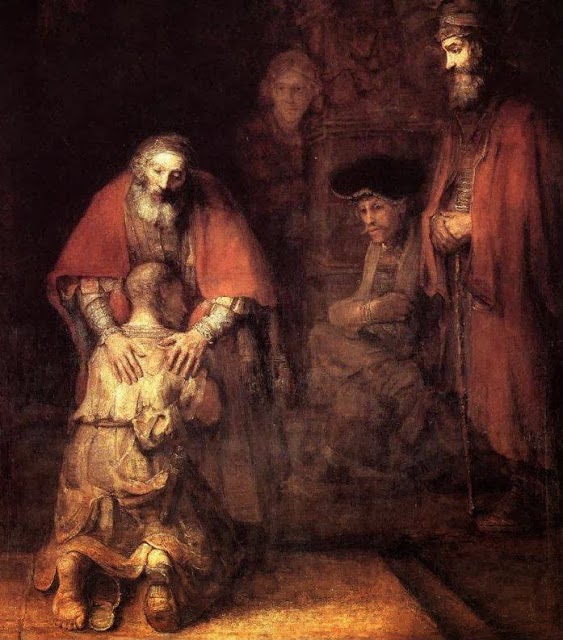
Henri Nouwen, the famous author, once gave a postcard print of Rembrandt’s painting pictured below, Return of the Prodigal, to individuals who had come to hear him speak. He asked them to look at the hands of father—one hand masculine and strong, and the other hand feminine and gentle. What a wonderful way to illustrate the unconditional love God has for all of us prodigals, full of grace and truth, His open arms saying, “You’re Loved.”


Take a few minutes to watch this powerful music video about the prodigal son called, When God Ran, He ran to His son saying, "You're Loved."


For I am persuaded, that neither death, nor life, nor angels, nor principalities, nor powers, nor things present, nor things to come, nor height, nor depth, nor any other creature, shall be able to separate us from the love of God, which is in Christ Jesus our Lord.—Romans  8:38-39 
For God so loved the world that he gave his one and only Son, that whoever believes in him shall not perish but have eternal life.—John 3:16 
This is love: not that we loved God, but that he loved us and sent his Son as an atoning sacrifice for our sins.—I John 4:10 
We love because he first loved us.—I John 4:19 

I pray this Coffee For Your Heart post has been encouraging to you, if it has been, please share your heart with me in the comments below, I’d love to hear your thoughts…


Friday, July 27, 2012

YOU put DELIGHT in me!


As I was driving to work the other day the Brandon Heath song, "The Light In Me" came on the radio. I began singing along and then suddenly, as if a voice was whispering in my heart, every time I sang the words of the song,"The Light"... what I heard in my spirit sounded like ..."De Light"... so I sang along with these new lyrics ... "You put De Light in me"... "You put DeLight in me"...  then suddenly ... an "ah-ha" God-moment ..."YOU put DELIGHT in me!"

What a joy! What a revelation! God himself put DELIGHT in me...I have always loved the Scripture Psalm 37:4…“Delight yourself in the LORD; and He will give you the desires of  your heart.”

Here on my blog, in October 2010, I wrote a blog post about it ... Delight yourself in the Lord


Whenever I hear
that song or read that Scripture, I am reminded of that moment, the "ah-ha" awareness of His Presence in my car with me as I drove to work and sang and listened to Him speak.


It is not me
who has to "work up" delight in the Lord, HE has already put DELIGHT in me :)


Here's the YouTube video
of Brandon Heath singing "The Light In Me" with a really cool visual movie playing in the background....with a surprise ending...be sure to watch til the end :)

 
In what ways does God speak to you?

Friday, September 9, 2011

Rembrandt's Return of the Prodigal

"The Return of the Prodigal Son" by Rembrandt
Henri Nouwen, the famous author, once gave a postcard print of this painting to individuals who had come to hear him speak.

He asked them to look at the hands of father--one hand masculine and strong, and the other hand feminine and gentle.

What a wonderful way to illustrate the unconditional love God has for all of us prodigals, full of grace and truth.

In what ways does this painting speak to you?

Thursday, July 28, 2011

be still my soul


frances mae carson willis

The song “Be Still My Soul” on Amy Grant’s Legacy CD played on “repeat” the entire time my Mom was in palliative care prior to her homegoing last year…it begins with a  melancholy guitar solo followed by the lyrics to “Be Still My Soul,” a haunting admonition to leave things in God's hands, culminating with a voice-over by Amy…my heart was so captured by it I wrote every word in the Bible I had with me…even now thinking about it brings back the flood of warm feelings I experienced during those days, knowing that Jesus was with me in her room…gently carrying her home…


Be still, my soul; the Lord is on thy side;
Bear patiently the cross of grief or pain;

Leave to thy God to order and provide;
In every change He faithful will remain.

Be still, my soul; thy best, thy heavenly, Friend
Through thorny ways leads to a joyful end.

Be still, my soul; thy God doth undertake
To guide the future as He has the past.

Thy hope, thy confidence, let nothing shake;
All now mysterious shall be bright at last.

Delight yourselves in the Lord, yes, and find your joy in Him.
      Be known for your gentleness and never forget the nearness of our God.
              Don’t worry, whatever is going to come, just tell God every detail,
                      and the peace of God that no one understands will come to you.
 No, don’t worry, just tell Him every detail and His peace will come to you.

_______________________________________________________________________

What are your thoughts about this post?
      In what ways have you experienced God's peace?
            Does a particular song bring back that memory to you?

Saturday, December 18, 2010

God's Word is a panpharmacon--a salve for every wound...

Jerusalem, Israel, view of the Western Wall--March 2000
God's Word is very precious to me. I can truly say that I love God's Word. It has changed me and my life. God's words are not ordinary words, as the words of other people are.

His words are filled with power. The power of God is actually inherent in His Word and it heals, delivers, comforts, saves, corrects, and encourages us.

When we are very discouraged, we can actually take God's Word as medicine for our souls. His Word is a panpharmacon--a salve for every wound. It encourages the discouraged, lifts up the lowly and downtrodden, heals the sick, saves the lost, fills the empty, and counsels those who need to make a decision.

Jesus is the Word of God Who took on human flesh and dwelt among us. When we read, study, meditate on, or confess the Word of God, we are fellowshipping with Jesus.

We are actually taking Him as nourishment and we find that only He can satisfy our souls. God's Word is our spiritual food and we need it regularly, just as we need natural food. "Your words were found, and I ate them; and your words were to me a joy and the rejoicing of my heart..."--Jeremiah 15:16.

(c) 2010 beth willis miller

Saturday, February 27, 2010

slowly, steadily, surely, the time approaches...


"Crown of Thorns" plant
These things I plan won't happen right away. Slowly, steadily, surely, the time approaches when the vision will be fulfilled. If it seems slow, do not despair, for these things will surely come to pass. Just be patient! They will not be overdue a single day!--Habakkuk 2:3 TLB

The name of the plant in this photo is "Crown of Thorns"...when I was 10 years old riding my bike on a sidewalk in front of Dee Kall's house on a Sunday afternoon, I lost my balance and fell into the "Crown of Thorns" she had planted beside her sidewalk. My left hand was covered with thorns, blood streaming from every puncture wound. I remember my Daddy carrying me into Dr. Watters' office on that Sunday afternoon, where he met us, and carefully pulled out every thorn, applying a salve to heal every wound.

That was the same year I came to the Cross of Jesus Christ, and to this day I experience morning after morning His Blood dripping over the Crown of Thorns on His brow, onto my heart, covering my sin, as I wear His Robe of righteousness. I made my public profession of faith in Jesus Christ at age 10, and was baptized by Pastor Rudy Fagan at First Baptist Church in Sebring. Eight years later, as a college student, I would work as a receptionist for two years in Dr. Jones' office, part of Dr. Watters' professional association. At the end of those two years, Dee Kall's daughter, Debbie, would take my place as the receptionist when I got married and moved to Tampa to get my BA at USF...so many connections woven together.

God is sovereign, He sees the past, the present, and the future all-at-once, He is the panpharmacon, the salve that soothes every wound. Lord Jesus, help me to live this day in the light of eternity...believing You...

These things I plan won't happen right away. Slowly, steadily, surely, the time approaches when the vision will be fulfilled. If it seems slow, do not despair, for these things will surely come to pass. Just be patient! They will not be overdue a single day!--Habakkuk 2:3 TLB

How about you? When you look back over your life, can you see evidence of how God has been there all along?

Saturday, December 26, 2009

Mount Tabor


As we passed by Mount Tabor in our tour bus, our tour guide said, "The only way to the top of Mount Tabor is by taxi on your next trip to Israel." Like so many of the inexhaustible places to visit in Israel, we will have to wait until our next trip to go to the top. This time we were only able to drive by Mount Tabor, just long enough to capture this photo from the bus, but long enough to imagine what it must have been like on that glorious transfiguration day through the excellent description and closing prayer in the book, "Meeting God in Holy Places," by F. LaGard Smith:

"Jesus' preeminence, messiahship, lordship, ultimate authority, and indeed, divinity were yet to be demonstrated. So we find Jesus taking Peter, James, and John and leading them "up a high mountain by themselves." At the top, the disciples were apparently taking a rest while Jesus was praying. Suddenly Jesus' face was seen to shine like the sun! The apostles would later describe Jesus' clothes as "dazzling white, whiter than anyone in the world could bleach them." Or "as bright as a flash of lightning!"

Then, amazement of all amazements, the three apostles saw Moses, and Elijah standing there with Jesus, talking about the events which would take place in Jerusalem when he would depart from the earth. Moses and Elijah were there, our spirits live beyond the grave! There was power of recognition whereby it was possible for Jesus and the apostles to know who Moses and Elijah were. Does this not suggest that on the other side, "I shall know fully, even as I am fully known," that you and I will be able to instantly recognize Moses and Elijah as if we had known them all over lives?

Then, a bright cloud enveloped them, and a voice from the cloud said, "This is my Son, Whom I love; with Him I am well-pleased. Listen to Him!" What God said of His Son that day on the summit of Mount Tabor was not just a repetition of what he had said on the occasion of Jesus' baptism: "This is my Son, Whom I love; with Him I am well-pleased." It's those three additional words--"Listen to Him!"--that tell the tale. The voice from Heaven. The voice of God. The thundering, awesome, terrifying voice of Jehovah saying, "Listen to Him!"

O Lord, hear my prayer. With each new day, speak to me out of the cloud. Let my face shine brighter and brighter with the light of Your Son. And may my own story end just as theirs ended that glorious day on Mount Tabor: "When they looked up, they saw no one except Jesus."

Blog Archive